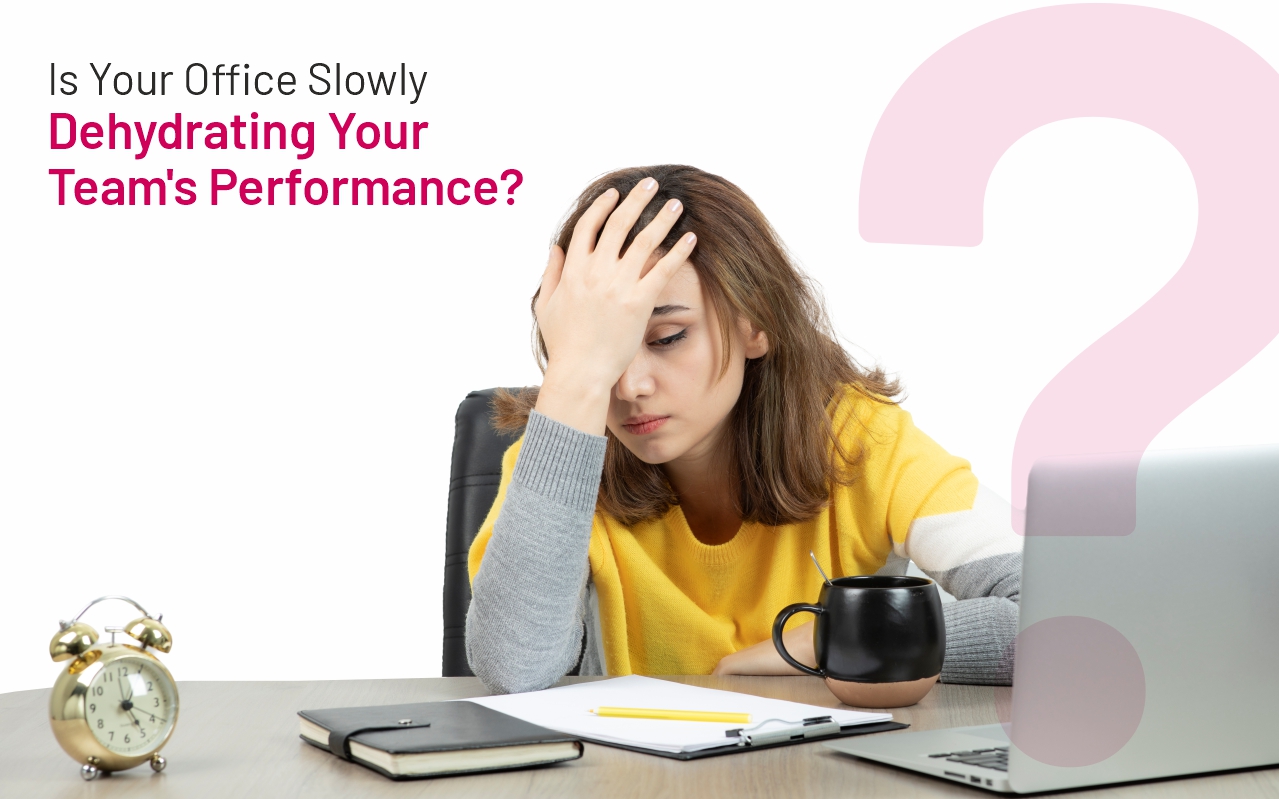
Is Your Office Slowly Dehydrating Your Team's Performance?
The science behind how mild dehydration mirrors the cognitive effects of being legally drunk and what smart companies across India are doing about it.
The Meeting Ends. The Decision Was Poor. Nobody Knows Why.
Your 11 AM review wraps up. A key call goes sideways. A report has a frustrating error that should not have happened. The team seemed sharp; everyone showed up and participated.
But here is what nobody checked: when did anyone last drink water?
In corporate offices across India, a silent performance drain happens every single workday. It does not show up on attendance reports. It does not trigger an HR alert. It is not visible on any dashboard. But its effects, reduced focus, slower decisions, lower output, and rising fatigue, are quietly costing organisations every single hour.
The cause is workplace dehydration. And for most businesses, it remains completely invisible until the damage is already done.
The Science Most Managers Have Never Heard
Most people associate dehydration with athletes under the open sun or labourers in extreme heat. The assumption is that office workers sitting comfortably in air-conditioned offices are simply not at risk.
That assumption is wrong. And the research makes it very difficult to ignore.
At just 1% dehydration, a level most people reach before they even feel thirsty, worker productivity drops by 12%. Concentration slips. Alertness fades. Short-term memory becomes unreliable. These are not dramatic symptoms. They are quiet, invisible drops in performance that most managers chalk up to attitude or effort.
At 3% dehydration, the cognitive impairment becomes equal to having a blood alcohol content of 0.08%, the legal drunk-driving threshold. Reaction time slows. Decision-making degrades. The thinking your team is paid to do becomes measurably, scientifically worse.
At 3 to 4% dehydration, overall productivity can fall by 25% or more. Here is the part that matters most: thirst is a delayed signal. By the time your employee reaches for their water bottle, their body has already been operating in a dehydrated state for some time. The dip in performance has already begun.
Why the Indian Office Is a Dehydration Machine
India has specific conditions that make dehydration at work a sharper, more serious problem than most corporate wellness programmes account for.
- Air conditioning accelerates fluid loss without warning : Conditioned air is dry air. When employees breathe it for eight or more hours, the lungs and skin lose moisture continuously, with no sweat, no sensation of heat, and no obvious signal. Research shows employees can lose over 400 mL of water in a standard air-conditioned workday through respiration alone. Air conditioning paradoxically reduces the feeling of thirst while accelerating fluid loss, which is exactly what makes office dehydration so invisible and so damaging.
- Indian summers push dehydration before the workday even starts : Temperatures across cities like Ahmedabad, Nagpur, Lucknow, and Hyderabad regularly hit 42°C to 47°C from April through June. Employees commuting in this heat arrive at the office already mildly dehydrated. Their workday begins with a deficit that compounds hour by hour, especially if the first thing they reach for is tea.
- Chai and coffee are not a replacement for packaged drinking water : In Indian offices, caffeine is a culture. Two cups of tea or coffee before 10 AM is entirely standard. But caffeine increases fluid loss. Relying on it as a primary morning beverage creates a hydration gap that quietly deepens through the rest of the day, affecting everything from focus to mood to decision quality.
- The modern workday is structurally designed against hydration : Research confirms that employees who do not keep water visible or easily within reach are significantly more likely to stay under-hydrated all day. Back-to-back meetings, continuous screen time, open-plan offices with distant pantries, remote work setups without a reliable office drinking water supply, the Indian corporate workday makes drinking water inconvenient without anyone intending it to be.
What Dehydration Looks Like on Your Team
The difficult thing about mild workplace dehydration is that it does not look like dehydration. It looks like something else entirely
The developer who keeps making small errors by the afternoon looks careless. The sales manager whose calls feel flat after lunch looks unmotivated. The analyst who takes longer than usual on a simple report looks distracted. The team member who snaps during a stressful review looks difficult to manage.
None of these is labelled as a hydration problem. All of them can be. When dehydration affects cognitive performance, the first things to go are the exact qualities office work demands most: concentration, short-term memory, reaction speed, and the ability to make clear decisions under pressure. The symptoms are subtle enough that neither the employee nor their manager connects them to water intake. And that is precisely why the problem persists.
The Productivity Maths Every Business Owner Should See
Consider a mid-sized Indian office with 50 employees. Average monthly payroll cost per employee: ₹50,000.
If mild dehydration reduces output by just 12% for even half the team consistently:
- 25 employees are working at 88% capacity every day
- Monthly value lost to under-performance: approximately ₹1.5 lakh
- Monthly value lost to under-performance: approximately ₹1.5 lakh Annually: over ₹18 lakh, for a problem that a good office hydration solution costs a small fraction of that to solve
A 2024 study from the Global Wellness Institute estimated that proper workplace hydration can improve productivity by 5 to 14% across knowledge-work sectors. For Indian businesses operating in a competitive environment where every rupee of output matters, this is not a wellness conversation. It is an operational efficiency conversation.
Packaged drinking water for your office is not a pantry perk. It is infrastructure, as essential as reliable internet, good lighting, or ergonomic seating.
What Smart Companies Are Actually Doing
Forward-thinking organisations across India are no longer treating hydration as a poster-in-the-pantry initiative. They are solving it the way they solve any operational problem, by making the right choice effortless and consistently available.
They move water to where people already are. Not one dispenser at the end of a corridor. Accessible, clean drinking water near workstations, inside meeting rooms, across reception areas and common spaces. The proximity of water directly determines how much of it gets consumed. This is not an opinion; it is what the research consistently shows.
They choose a quality that employees actually want to drink. Studies have found that a significant number of workers avoid office water simply because it does not taste clean or fresh. When premium packaged drinking water is available, consistently pure, correctly sealed, and properly stored, consumption rises naturally without any campaign or reminder.
They remove the supply burden entirely. Offices that rely on small individual bottles run into constant reordering, inconsistent stock, and unnecessary plastic waste. A scheduled bulk delivery of 20-litre water jars, reliable, doorstep, on time, means the team never goes without, and the admin team never has to think about it.
They treat hydration as part of workplace culture. Water available during long training sessions. Hydration access at every internal event. Leaders who visibly drink water signal to their teams that it matters. When the organisation treats employee hydration as a priority, behaviour follows naturally.
Gallons Premium Water, The Office Hydration Solution Built for India
At Gallons Premium Water, we are a BIS-certified manufacturer of premium packaged drinking water, supplying corporate offices, hospitals, hotels, and institutions across 12+ states in India. We understand what consistent, large-scale office hydration supply requires, not just once, but every day, reliably, without interruption.
Every bottle and jar of Gallons passes through a 12-stage purification process backed by a 121-point quality check, so what reaches your employees is consistently pure, safe, and clean-tasting. Our 20L reusable water jars are designed specifically for offices and institutional buyers, cost-efficient, sustainable, and delivered on schedule, so your supply never runs short.
We have kept 35,000+ scouts hydrated across 7 days at the National Jamboree in Lucknow. We were the official hydration partner for the BNI Ahmedabad Symposium, serving 10,000+ business leaders. We supplied the Banaras Lit Fest and the GCCI GATE Exhibition 2026. We know what it means to deliver packaged drinking water for offices, institutions, and events at scale, without compromise, without interruption.
That same operational reliability comes to your office every single week.
The Fix Is Simpler Than the Problem
You have invested in ergonomic chairs, fast internet, performance tools, and team training. All of that investment performs better when your people are properly hydrated
The 3 PM slump your team blames on lunch is often dehydration. The afternoon dip in output you attribute to workload is often dehydration. The small errors, the irritability, and the lack of sharp focus that good managers try to address through motivation or management are often due to dehydration.
The solution does not require a budget overhaul. It requires a reliable, high-quality office drinking water supply, placed where your people are, available throughout their day, delivered without interruption.
That is what Gallons Premium Water does for corporate offices across India.
Get in touch with our corporate supply team today
Gallons Premium Water, BIS Certified | 12-Stage Purification | 121-Point Quality Check | Trusted across 12+ States in India
FAQs
Neelesh Agrawal
Co-founder, Gallons · Sygnia Brandworks LLP
Neelesh co-founded Gallons in 2002 in Ahmedabad. He's spent the last two decades building plants, managing distribution networks, and writing about the operational side of the bottled water industry — the part the pitch decks don't cover.
More articles by Neelesh