How Technology Transformed India's Packaged Water Industry
From manual filling lines to 12-stage purification, QR-code traceability, and 1.5 lakh bottles per hour, the engineering behind modern water
In 1990, Bottled Water Was a Luxury. In 2025, It Is a ₹32,000 Crore Industry. Technology Made the Difference.
Think back to what packaged drinking water looked like in India three decades ago.
A small number of brands. Limited availability. Manual production lines where human hands touched every stage of the process. Quality that varied from batch to batch. No standardised testing. No regulation with real teeth. No way for a consumer to verify what was actually inside the bottle they were drinking.
That world is almost unrecognisable today.
India's packaged drinking water industry is now valued at over ₹32,000 crore and is projected to reach ₹57,850 crore by 2032, growing at an 8.8% CAGR. The premium water segment is expanding even faster, at 11.71% annually, driven by rising health awareness, urbanisation, and a consumer base that increasingly wants to know exactly what they are drinking, and exactly how it was made.
This transformation did not happen because demand grew. It happened because technology changed what was possible and what was acceptable.
Where It All Started: The Era of Manual Production
In the early years of India's packaged water industry, production was largely manual. Bottles were filled, capped, and labelled by hand. Quality control depended heavily on the attention and judgment of individual workers at each stage. Consistency was difficult to guarantee. Contamination risk was high. And because there was no systematic testing framework, problems often went undetected until they reached the consumer.
The result was an industry that consumers approached with justified scepticism. Packaged water existed, but trust in it was fragile, and for good reason.
Two forces changed this. First, regulation began to take shape. Second, and more powerfully, technology arrived.
Stage One: Purification Gets Serious
The first major technological shift came in water purification itself.
Where older systems relied on simple filtration and basic chlorination, modern packaged drinking water manufacturing now uses multi-stage purification processes that remove contaminants at every level, physical, chemical, and microbiological.
Reverse Osmosis (RO) became the foundation. RO systems use a semi-permeable membrane under high pressure to remove dissolved salts, heavy metals, fluoride, nitrates, pesticide residues, and organic compounds that basic filtration simply cannot address. In a country where groundwater in states like Rajasthan, Maharashtra, and Uttar Pradesh regularly exceeds safe limits for nitrates and fluoride, RO is not optional; it is essential.
UV Disinfection added a chemical-free layer of biological protection. Ultraviolet light disrupts the DNA of bacteria, viruses, and pathogens, rendering them unable to reproduce and effectively eliminating them, without adding any chemicals to the water or altering its taste
Ozone Treatment completed the picture. Ozone is one of the most powerful natural disinfectants available. When injected into water before the final filling stage, it destroys any remaining microorganisms and extends shelf life without leaving a residual taste or chemical trace.
Together, RO, UV, and ozone treatment form the scientific backbone of modern packaged water purification. A well-engineered system combines all three and adds additional stages for sediment filtration, activated carbon treatment, micron filtration, and mineral balancing to produce water that is genuinely pure at every measurable parameter.
At Gallons Premium Water, every drop passes through a 12-stage purification process before it ever reaches a bottle. Each stage is designed to address a specific category of contamination, with nothing left to chance and no stage skipped.
Stage Two: Automation Eliminates Human Contact
Purification alone was not enough. The second revolution in packaged water technology was automation, and it changed everything about how trust is built in this industry.
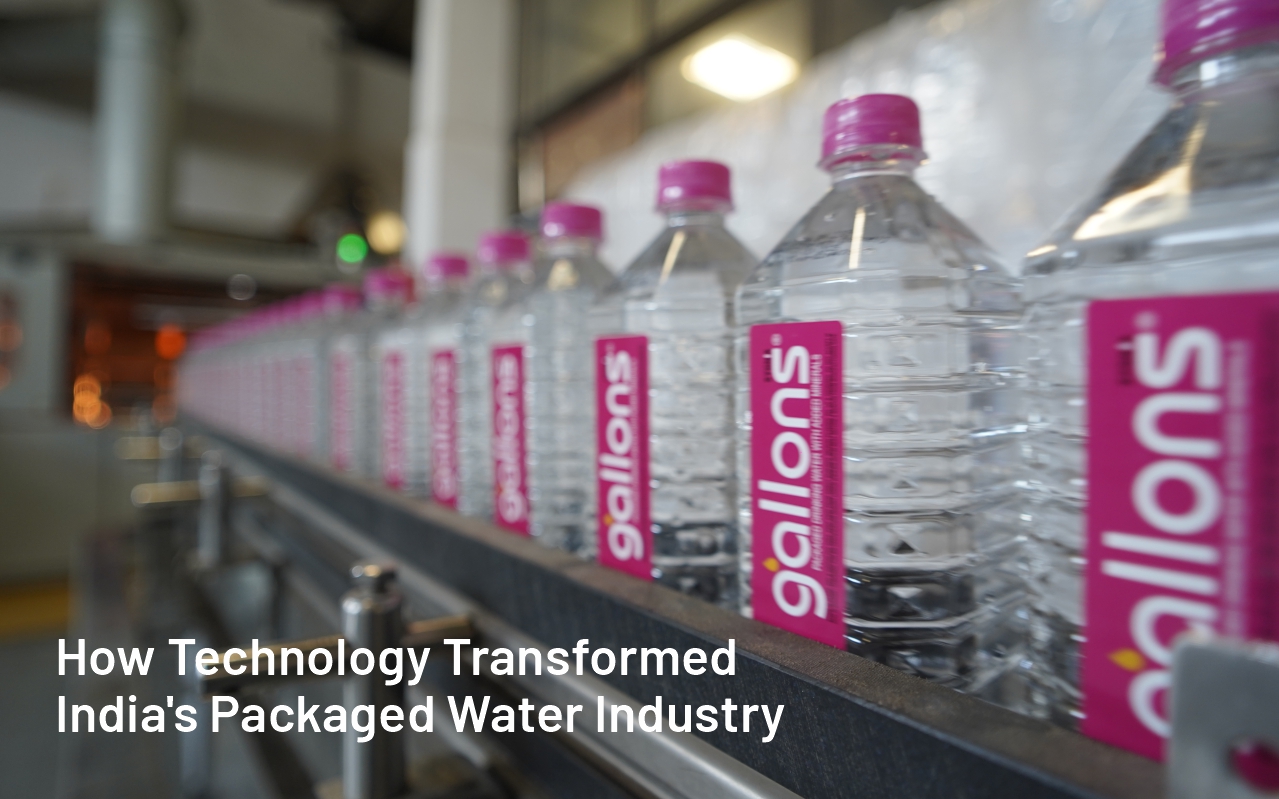
In a fully automated packaged drinking water manufacturing plant, the production process from raw PET resin to finished, sealed bottles involves minimal to zero human contact.
Here is what that looks like in practice:
- Bottle blowing from virgin PET resin: Bottles are not pre-manufactured and are transported. They are blown on-site from high-grade virgin PET resin using stretch blow moulding machines. This means no external contamination from storage, handling, or transport of empty bottles before filling. The bottle that holds your water was created minutes before it was filled.
- Automated rinsing, filling, and capping: happen in a sealed, controlled environment, typically a clean room with filtered air systems, where the bottle goes from formation to sealed cap without any human hand making contact with the interior or the water. Filling speed, volume precision, and sealing torque are all managed by the machine to exact specifications.
- Inline labelling and batch coding: happen automatically at production speed, with each bottle receiving its label and unique identification code in the same continuous process.
The result is a production line where consistency is not dependent on human attention or effort. It is engineered into the system itself.
At Gallons, our automated production lines operate at a capacity of 1,50,000 bottles per hour across 14 manufacturing units spanning 12+ states across India. That scale is only possible because the process is built on technology, not manual labour.
Stage Three: Quality Control Becomes a System, Not a Spot Check
The third transformation technology brought to the packaged water industry was in quality control, shifting it from a periodic spot check to a continuous, systematic process embedded into every stage of production.
Modern water manufacturing quality control operates at multiple levels simultaneously.
In-process monitoring tracks water quality parameters in real time as water moves through purification stages. TDS (total dissolved solids), pH, turbidity, and microbial counts are measured continuously, not just at the end of the line. If any parameter drifts outside acceptable limits, the system flags it immediately, before the water reaches filling.
Batch laboratory testing verifies every production batch against the full range of microbiological and chemical parameters required by FSSAI and international standards. This includes testing for coliform bacteria, Pseudomonas aeruginosa, E. coli, heavy metals, pesticide residues, fluoride, nitrates, and dozens of other contaminants.
Packaging quality verification checks every bottle for leakage resistance, seal integrity, structural strength, and labelling accuracy before it leaves the facility.
At Gallons Premium Water, our quality control system runs a 121-point quality check on every single bottle, covering everything from raw material quality and purification parameters to packaging durability and final seal inspection. Not one bottle leaves our facility without passing every point on that checklist.
Stage Four: Traceability Brings Transparency to the Consumer
Perhaps the most significant recent development in packaged water technology is the introduction of consumer-facing traceability, and it is changing the relationship between manufacturers and the people who drink their water
A QR code on a bottle of water might seem like a simple thing. What it represents is far more significant: a direct, verifiable link between the consumer and the specific manufacturing batch, production date, facility, and quality test results for the water they are holding.
Before this technology existed, a consumer had to take the manufacturer's word for quality. Now, they can verify it.
At Gallons, every bottle carries a unique QR code that allows any consumer to instantly access the batch details, manufacturing information, and quality documentation for that specific bottle. This is not marketing; it is accountability. It is the kind of transparency that only technology makes possible, and it is the direction the entire industry is moving.
The Regulatory Evolution: From BIS Marks to Continuous Compliance
Technology did not transform the packaged water industry alone. Regulation evolved alongside it, and the two have pushed each other forward.
For years, the Bureau of Indian Standards (BIS) certification under IS 14543 was the primary quality marker for packaged drinking water in India. It established baseline standards and gave consumers a recognisable symbol of compliance.
In October 2024, FSSAI made a landmark regulatory shift: mandatory BIS certification for packaged drinking water was removed. In its place, FSSAI introduced a comprehensive Scheme of Testing that came into force from January 1, 2026, a significantly more rigorous framework that requires:
- Monthly microbiological testing for coliform bacteria, Pseudomonas aeruginosa, Salmonella, E. coli, and other pathogens
- Regular chemical and heavy metal testing through FSSAI-notified, NABL-accredited laboratories
- Source water monitoring before each production cycle
- Detailed record-keeping of all test results, available for regulatory inspection
- Immediate corrective action and five consecutive passing batches are required before resuming production after any non-compliance
This shift moves compliance from a logo on a label to a continuous, documented, laboratory-backed process. For manufacturers who were already operating at high standards, this change is a natural extension of existing practice. For those who were relying on a certification mark without the underlying systems to support it, the new framework is a serious challenge.
At Gallons, our 12-stage purification process, 121-point quality checks, and real-time monitoring systems were built precisely for this level of accountability. We do not simply meet regulatory requirements. We build systems that make compliance the natural outcome of how we operate.
What "Engineered Purity" Actually Means
At Gallons Premium Water, we use the phrase Engineered Purity to describe what modern water manufacturing represents, and why it matters.
Purity in packaged water is not an accident. It is not a claim. It is the output of a precisely designed, continuously monitored, rigorously tested engineering system, one that removes every known category of contamination, eliminates every point of human error, and verifies every batch before a single bottle reaches the outside world.
Every stage of our production process, from virgin PET resin selection to 12-stage purification, fully automated bottling, 121-point quality checks, and QR-code batch traceability, exists because purity at scale requires engineering, not just intention.
With 14 manufacturing units, presence across 12+ states, and a production capacity of 1,50,000 bottles per hour, Gallons is built to deliver that engineered purity consistently, not just when conditions are ideal, but every single day, for every bottle, across every state we serve.
The Industry Is Still Transforming, and the Best Is Ahead
The packaged drinking water industry in India is entering its next phase of technological evolution.
AI-enabled purification systems that monitor and adjust filtration parameters in real time are being developed. Smart packaging that communicates storage temperature and shelf-life data is emerging. Sustainable PET innovations are reducing the environmental footprint of production. And consumer demand for full transparency, knowing exactly what is in their water and exactly how it was made, is only growing stronger.
India's bottled water market is projected to reach USD 9.23 billion by 2032. The brands that will lead that growth are not the ones with the biggest advertising budgets. They are the ones that invested in the right technology, built the right systems, and earned trust through consistency, not through claims.
At Gallons, that is the only way we have ever built anything
Gallons Premium Water, Engineered Purity | 12-Stage Purification | 121-Point Quality Check | 14 Manufacturing Units | 12+ States across India
FAQs
Neelesh Agrawal
Co-founder, Gallons · Sygnia Brandworks LLP
Neelesh co-founded Gallons in 2002 in Ahmedabad. He's spent the last two decades building plants, managing distribution networks, and writing about the operational side of the bottled water industry — the part the pitch decks don't cover.
More articles by Neelesh