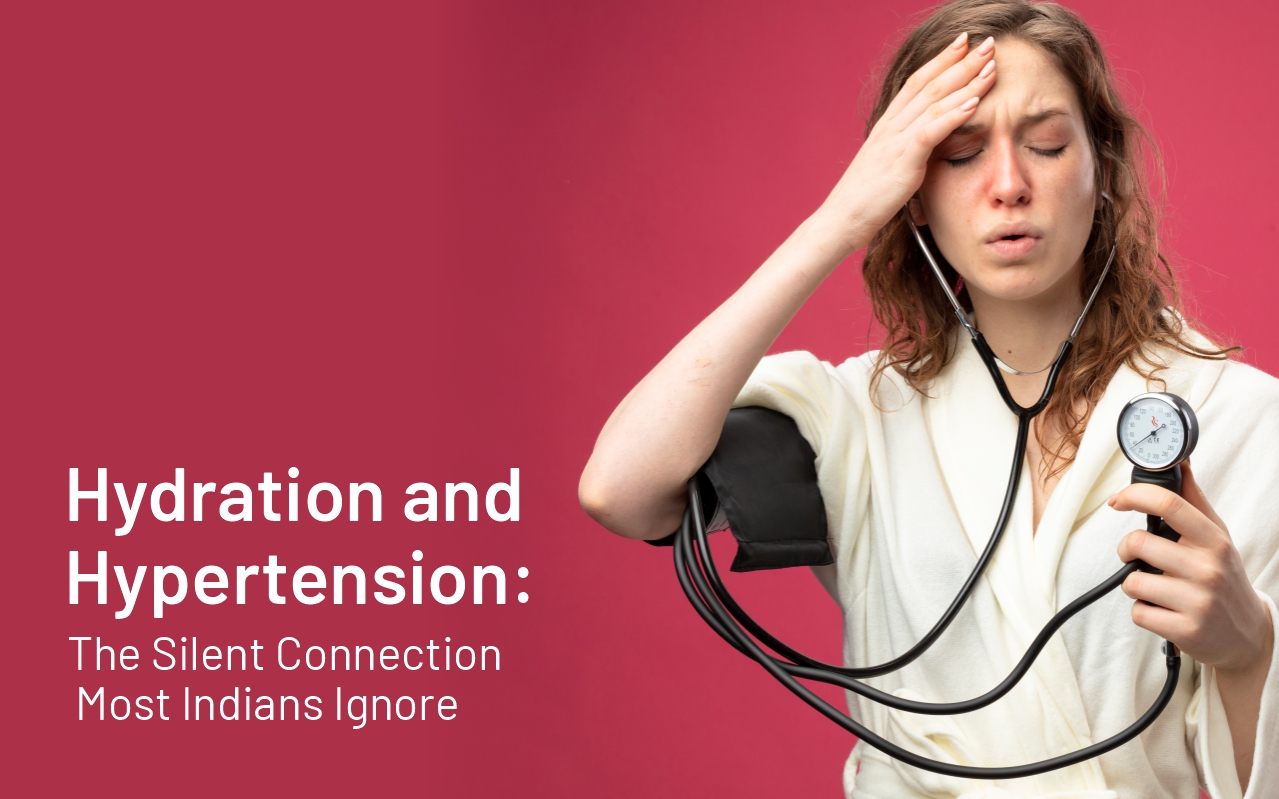
Hydration and Hypertension: The Silent Connection Most Indians Ignore
With 220 million Indians living with high blood pressure, here's why daily water intake is your simplest cardiovascular habit.
The Number Nobody Talks About at the Dinner Table 220 millions
That is the number of Indians currently living with hypertension, according to the World Health Organisation. It is not a distant statistic. It is roughly one in six people in this country, your colleague, your parent, your neighbour, possibly you, walking around with blood pressure that is silently damaging their heart, brain, and kidneys every single day.
What makes this number truly alarming is what sits alongside it: of those 220 million Indians with hypertension, only 12% have their blood pressure under control.
The rest, the overwhelming majority, are either undiagnosed, undertreated, or simply unaware of what is happening inside their bodies. Hypertension earns its name as the silent killer, not because it is rare, but because it causes no pain, no obvious symptom, no warning sign, until it announces itself as a heart attack, a stroke, or kidney failure
And it is no longer just a disease of age. Today, 1 in every 5 heart attack patients in India is below 40. Cases among the 25 to 40-year-old age group have doubled in the past decade. Young professionals with no prior cardiac history are being rushed into emergency rooms across the country. The Indian Heart Association reports that nearly 25% of all heart attacks in Indian men occur before the age of 40.
India is facing a cardiovascular crisis. And most of the conversation around it focuses on medication, stress management, and dietary sodium, while completely ignoring one of the simplest, most accessible contributing factors: how much water people drink every day.
The Physiology Nobody Explains Simply Enough
To understand why hydration matters for blood pressure, you need to understand what happens inside your body when it runs low on water, and the answer is more alarming than most people expect.
When the body becomes dehydrated, it does not simply feel thirsty and wait. It launches a series of protective hormonal responses designed to preserve whatever fluid remains, and those responses directly raise blood pressure.
- Step 1: Blood volume drops: Blood is approximately 90% water. When fluid levels fall, blood volume decreases, and blood becomes more viscous, thicker and harder to pump. The heart immediately has to work harder to keep circulation going, which increases pressure on arterial walls.
- Step 2: The kidneys activate the RAAS: As blood volume drops, the kidneys detect reduced blood flow and trigger the Renin-Angiotensin-Aldosterone System (RAAS), one of the body's most powerful blood pressure regulation mechanisms. The kidneys release renin, which converts into angiotensin II, a potent vasoconstrictor. Blood vessels narrow. Resistance in the arteries rises. Blood pressure goes up.
- Step 3: Vasopressin constricts blood vessels further: Simultaneously, the body releases vasopressin (also called antidiuretic hormone), which signals the kidneys to retain water. Vasopressin also directly constricts blood vessels, narrowing them further and increasing vascular resistance, which pushes blood pressure highe
- Step 4: Sodium retention worsens the cycle: The hormonal cascade causes the kidneys to retain sodium. Higher sodium concentration in the blood draws more water into the bloodstream to compensate, increasing blood volume, but also increasing the pressure the heart must generate to circulate i
The National Institutes of Health (NIH) published research confirming a strong association between hypertension status and hydration parameters, concluding that hypohydration, a state of lower-than-normal body water, can be a direct contributing factor to hypertension. A 2024 study published in Frontiers in Public Health, covering over 3,000 adults, found a clear decreasing trend in hypertension risk as plain water intake increased. Participants consuming 6 to 8 cups of water per day had measurably lower risk of developing hypertension
Why Indians Are Specifically at Risk
Every country faces hypertension. But India faces it at a scale and pace that requires specific attention, and several factors unique to Indian life make the hydration connection even more critical here.
Indian summers are physiologically extreme. Temperatures across large parts of India, Rajasthan, UP, Madhya Pradesh, Maharashtra, Telangana, and Gujarat regularly hit 44°C to 48°C between April and June. At these temperatures, the body can lose 1 to 1.5 litres of water per hour through sweat alone. Chronic, repeated fluid loss without adequate replacement is a direct route to the dehydration-hypertension cycle described above. For outdoor workers, daily commuters, and anyone not actively monitoring their water intake, this is a daily physiological reality.
Urban work culture creates structural dehydration. India's urban professionals are among the most chronically under-hydrated groups in the country. Back-to-back meetings, heavy reliance on tea and coffee instead of water, air-conditioned offices that reduce thirst perception while accelerating fluid loss through respiration, the modern Indian workday is systematically designed to keep people from drinking enough water. A 2025 study found that employees who did not keep water easily accessible regularly went 4 to 5 hours without any fluid intake.
Awareness is dangerously low. The NFHS-5 (National Family Health Survey) found that hypertension prevalence in India stands at 22.6%, with men at 24.1% and women at 21.2%. Among those aged 60 and above, prevalence exceeds 48%. Yet awareness, treatment, and control rates remain critically low. Studies show that a significant proportion of Indians with hypertension have never been formally diagnosed. They feel fine. They go about their day. The damage accumulates silentl
Indians carry a higher genetic cardiovascular risk. Research consistently shows that South Asians develop cardiovascular disease 5 to 8 years earlier than Western populations. The Indian body type is more prone to central obesity, abdominal fat that directly compounds hypertension risk. Combined with the lifestyle pressures of modern urban India, this genetic predisposition makes preventive habits, including proper hydration, more important here than almost anywhere else in the world.
What Hydration Actually Does for Your Heart
Let us be honest about what water can and cannot do
Water alone does not cure hypertension. It does not replace medication for someone with clinically high blood pressure. Anyone managing a diagnosed cardiovascular condition should follow their doctor's guidance above all else
What consistent, adequate hydration does is remove one significant contributing factor to elevated blood pressure, chronic, low-grade dehydration, from the equation entirely. And the evidence for this is growing stronger.
When you are consistently well-hydrated
- Blood viscosity stays normal, reducing the strain on the heart to pump effectively
- The RAAS system is not chronically activated, meaning vasoconstriction is not a daily default state
- Kidney function is optimally supported, the kidneys are responsible for long-term blood pressure regulation, and they require adequate water to work properly
- Sodium is flushed more efficiently, reducing the fluid retention cycle that contributes to sustained high pressure
- Blood vessel walls face less repeated mechanical stress from thick, high-resistance blood flow
A 2025 study published in JACC Advances specifically examined the medium-term cardiovascular effects of increased water intake and found measurable benefits in cardiovascular health markers among participants who consistently increased their daily fluid intake.
The science supports a clear position: proper hydration is not sufficient on its own to treat hypertension, but chronic dehydration is a meaningful, underappreciated contributor to it, and removing that contributor has measurable cardiovascular benefit
The Indian Urban Professional: A Case Study in Silent Risk
Consider the profile of a typical urban Indian professional in their 30s.
Wakes up at 7 AM. Rushes through a morning with chai, no breakfast, and water. Commutes in 40°C heat for 45 minutes. Arrives at an air-conditioned office already mildly dehydrated. Has two more cups of tea by 10 AM. Sits through back-to-back meetings from 11 AM to 2 PM with no water break. Eats a sodium-heavy lunch. Continues working until 7 PM. Feels tired, slightly headachy, attributes it to work stress. Goes home. Sleeps. Repeats.
This person has likely consumed under a litre of water in a 14-hour day in a country with some of the most extreme heat conditions on the planet. Their kidneys have been compensating since morning. Their RAAS has been activated. Their blood pressure has been running higher than it should have, not because of a serious disease, but because of a habit nobody ever told them to fix.
Multiply this profile across millions of urban Indians, and the scale of the problem becomes clear. This is not a medical crisis requiring only hospital intervention. It is a daily habit crisis, and daily habits are where intervention is both possible and powerful
Five Hydration Habits That Support Cardiovascular Health
These are not medical prescriptions. They are evidence-informed daily practices that support blood pressure regulation through consistent hydration.
- Start before thirst: Thirst is a late signal. By the time you feel thirsty, your body has already lost 1 to 2% of its water, and your RAAS may already be responding. Begin every morning with 1 to 2 glasses of water before tea, coffee, or food.
- Match your intake to your environment: In Indian conditions, especially April through June, 3 to 3.5 litres of fluid per day is a practical baseline for most adults. In peak heat, outdoor activity, or long commutes, this needs to go higher. The formula: bodyweight in kg multiplied by 0.03 gives a base daily litre requirement.
- Keep water where your eyes already go: Research consistently shows that proximity determines consumption. If water is not within arm's reach of where you work, you will not drink it consistently. A water bottle on your desk, a jar in your kitchen line of sight, water on your dining table, placement is strategy.
- Check the urine colour test: Pale yellow means you are adequately hydrated. Dark yellow means drink immediately. This is the simplest real-time hydration check available, no device, no app, no cost.
- Choose water quality that you will actually drink: People avoid water that does not taste clean. Consistently poor-tasting water leads to chronically low consumption. Access to purified, fresh-tasting water, whether at home or at work, is the foundation that makes every other hydration habit possible
Why Water Quality Matters as Much as Water Quantity
There is a final piece of the hydration-hypertension conversation that rarely gets addressed: not all water supports cardiovascular health equally.
India's groundwater contamination crisis is documented and serious. Research shows that 20% of India's groundwater samples exceed permissible pollutant limits. Rajasthan has fluoride and nitrate contamination in over 25% and 40% of tested sources, respectively. Maharashtra reports over 35% nitrate contamination. Consuming water with high levels of nitrates, heavy metals, or fluoride does not just fail to help blood pressure; it actively stresses the kidneys and cardiovascular system that you are trying to protect.
Purified, clean, packaged drinking water, free of contaminants, produced to verifiable quality standards, is not a luxury for people managing hypertension or cardiovascular risk. It is the baseline from which consistent, beneficial hydration actually becomes possible.
Gallons Premium Water, Built Around the Daily Habit That Protects You
At Gallons Premium Water, we have spent over two decades building one thing: a water supply that Indians can rely on every single day, without question, without compromise.
Our 12-stage purification process removes nitrates, fluorides, heavy metals, bacteria, and all microbiological contaminants. Our 121-point quality check ensures that every bottle and 20L jar that reaches your home, office, or institution meets the highest standards of purity. Every batch is traceable through a unique QR code, so you are never left trusting a label you cannot verify.
Across 12+ states, 14 manufacturing units, and partnerships with hospitals, corporate offices, hotels, and institutions, Gallons is built for the daily Indian reality, where extreme heat, poor infrastructure, and busy schedules conspire against the simplest health habit most people own.
We cannot fix India's hypertension crisis alone. No water brand can.
But we can make sure that every time you reach for water, you are drinking something genuinely worth reaching for
Get in touch with our corporate supply team today
Gallons Premium Water, BIS Certified | 12-Stage Purification | 121-Point Quality Check | Trusted across 12+ States in India
Frequently Asked Questions
Neelesh Agrawal
Co-founder, Gallons · Sygnia Brandworks LLP
Neelesh co-founded Gallons in 2002 in Ahmedabad. He's spent the last two decades building plants, managing distribution networks, and writing about the operational side of the bottled water industry — the part the pitch decks don't cover.
More articles by NeeleshRelated articles.
Is Your Office Slowly Dehydrating Your Team's Performance?
The science behind how mild dehydration mirrors the cognitive effects of being legally drunk and what smart companies across India are doing about it.
How Technology Transformed India's Packaged Water Industry
From manual filling lines to 12-stage purification, QR-code traceability, and 1.5 lakh bottles per hour, the engineering behind modern water